
If you are an architect, magazine editor, or student about to post photos of your latest project on your website or social media, stop for a second: do you know who legally owns those images? Remember: without images, there is no memory, and without authors, there is no history.
Throughout my 15+ years documenting projects and crafting visual Documents of Intent for the Biennale, I have proven that most architectural works would remain invisible without the work of photographers and filmmakers.
Paying for a photo shoot does not automatically make you the absolute owner of the images; to use them, you must respect the moral right of paternity (giving credit to the creator) and have a clear license for economic rights. As our guild says: crediting is not a favor; it is recognizing that buildings are constructed, but images are too.
In this article, we will demystify image usage on the internet and explain 5 real-life best practices in Colombia to correctly use, publish, and credit architectural photography without legal risks.
The Myth of "I Found It on Google, It's Public"
A common error in the construction and design industry is assuming that a photo published on the internet has no owner. The golden rule here is: Published does not mean free to use. The public availability of an image does not imply authorization for its reproduction or redistribution. Every use must respect authorship, usage rights, and the conditions defined by its creator.
The protection that law grants to a work is born automatically at the moment of creation, without its protection being subordinated to any formal registration. Recently, in 2024, the Superior Court of Bogotá ruled in favor of an architectural and urban landscape photographer, ordering a real estate firm to pay an indemnity of $7,000,000 COP for moral damages after using a panoramic photograph on their website without authorization or credit. The court was clear: responsibility for copyright infringement in the digital environment is objective; whoever decides to upload the photo to a platform is responsible, regardless of how many visits the site receives.
5 Best Practices for the Use and Attribution of Architectural Photography
1. Crediting Is Not a Favor: Mutual Respect for Shared Authorship
Architecture and design are collaborative disciplines. Every successful architectural project has a shared authorship: the structural design belongs to the architect, but the visual essay belongs to the photographer. Recognizing both authorships strengthens the entire creative community and promotes a professional culture based on respect and transparency. Best practice requires: requesting complete credits when participating in awards, making proper and visible attribution according to the medium, and tagging creators on social media. When a credit disappears, it is not just a name that vanishes; a part of the building's history vanishes as well.
2. Understanding the Difference Between Paying for a Session and Buying the Rights
Paying a photographer's fees does not mean buying their intellectual property. What you purchase is an authorization or usage license (economic rights) for specific purposes (such as reproduction or public communication). Unless there is a written contract for a full transfer of rights, the photographer remains the only party authorized to sell or license that image to third parties (magazines, material suppliers, etc.).
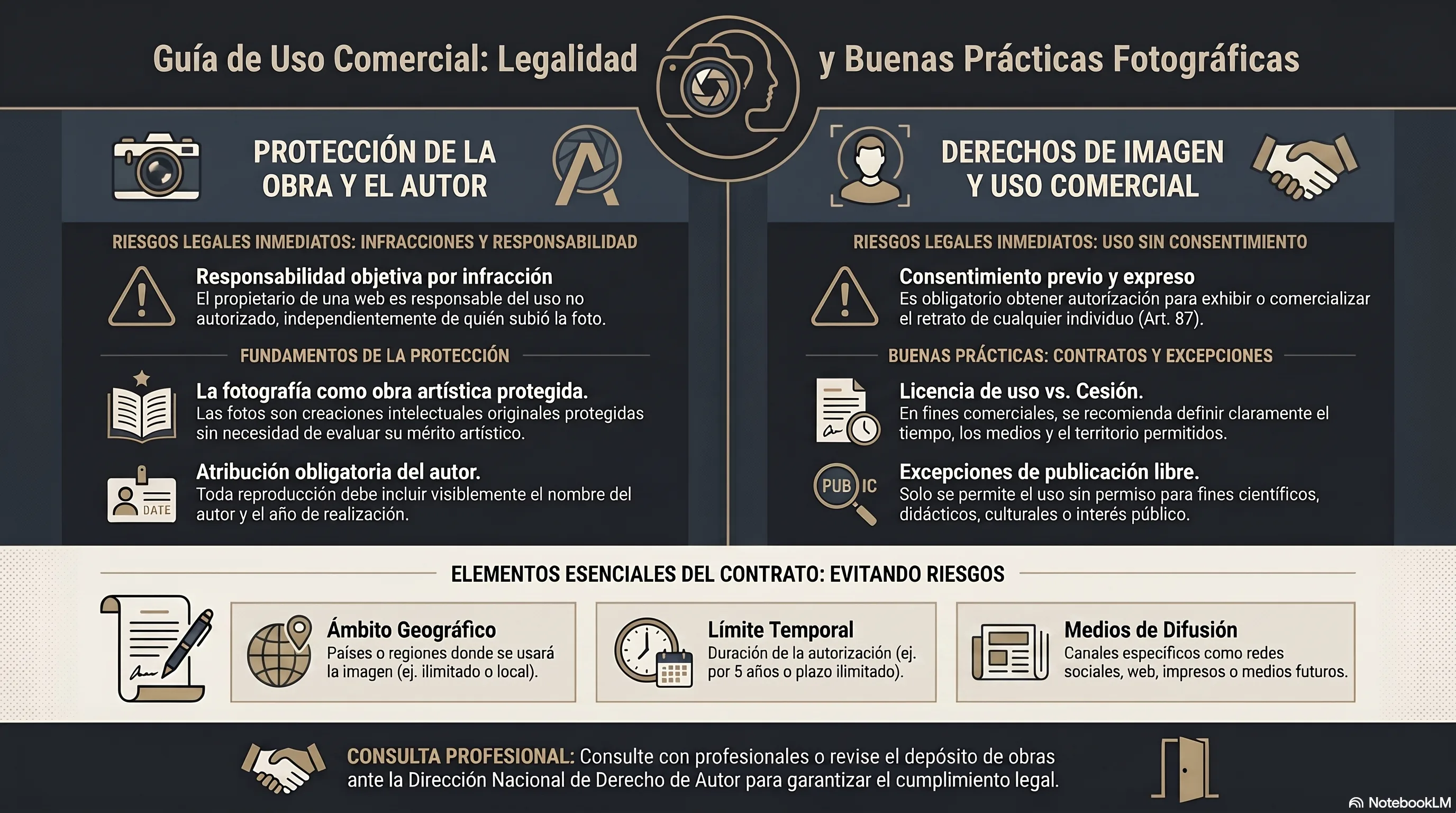
Commercial Photographic Use Guide: licensing, economic rights, and copyright assignment.
3. An Image Is Not an Attachment (Protect the Document of Intent)
Photography and audiovisuals are not merely supporting documents; they are interpretations, readings, and cultural constructions of architecture and design. Perspective corrections, lighting adjustments, and editing choices made by the photographer are deliberate narrative decisions. Applying generic Instagram filters, cropping the image arbitrarily, or erasing the watermark violates the Right to Integrity of the work, which allows the author to oppose any deformation that mutilates or devalues their creation.
4. Managing Human Scale and the Right of Publicity
At Sitio Estudio, we always emphasize that architecture without human scale is a "lifeless model." However, when we include recognizable people inhabiting the site, the Right of Publicity (Image Rights) comes into play. Generally, the commercial use of a passerby's likeness requires authorization. Fortunately, Colombian Law 23 of 1982 (Article 36) establishes that publishing portraits is free when it is related to educational, cultural, or public interest purposes. Furthermore, Article 39 allows the reproduction and distribution of photographs of works permanently located in public roads or plazas.
5. Awards Set Standards (Clear Agreements from the Start)
Architecture awards not only recognize excellence but also establish benchmarks for the entire industry. That is why best attribution practices have an impact that goes beyond each individual publication. The best path is to get everything in writing in a clear contract before setting foot on the site, specifying the scope of rights: time, territory, media channels (social networks, books, portfolio sites), and whether exclusivity exists.
Conclusion: A Healthy Creative Ecosystem Recognizes All Its Actors
Documenting architecture is not just a visual procedure; it is building the historical memory of a place. Using images correctly and providing corresponding credits is not just a legal obligation to avoid penalties; it is an act of deep respect for the creative chain that allows the "truth of the place" to be admired by the rest of the world.